Skip to content

Daily weight,
smarter decisions

CowFIT measures every cow's weight daily

Why does correct energy balance matter?

A cow’s body condition naturally changes throughout her lactation. After calving, she uses body reserves to support high milk production because her energy needs exceed the energy she can get from feed. Later in lactation, milk production declines, energy balance improves, and the cow begins to regain weight in preparation for her next calf. These changes are normal—but when they become too extreme, they can impact performance, fertility, health, and profitability.

5 reasons why

dairy farmers choose CowFIT

CowFIT weight monitoring system automatically measures every cow's weight every day using AI-powered 3D camera technology when a cow's weight is not developing as expected. By monitoring individual cows, groups of cows, and the entire herd, you can detect changes early and improve performance.  

Reason 1

Spot energy imbalance before it costs you

 Changes in body weight reveal how cows adapt to their energy demands. CowFIT continuously tracks weight development across lactation and the dry period, identifying when cows move away from expected patterns. The goal is to avoid excessive weight loss in early lactation, excessive weight gain in late lactation, and weight changes during the dry period. In one CowFIT herd, where 52% of cows maintained stable dry-period weight, these cows produced 874 kg ECM more (12,853 kg ECM on average) in the following lactation than cows that lost 50 kg, and 1,074 kg ECM more than cows that gained 50 kg. 

CowFIT continuously tracks weight development
Reason 2

Act earlier - take action before performance drops

The right information at the right time helps you act early. Instead of relying on occasional body condition scoring, CowFIT provides daily objective weight measurements over the entire lifetime of each cow. This helps you identify critical weight changes early and adjust feeding and management before production, fertility, and health are affected.

CowFIT camera provides daily objective weight measurements
Reason 3

Reduce breeding costs and cow losses

Knowing when cows have returned to positive energy balance helps improve insemination timing. Farmers using weight data to support breeding decisions have reduced number of inseminations per pregnancy from 2.2 to 1.8. One of the CowFIT customers reported a 90% reduction in cow mortality after using weight data to improve dry-period management, with losses falling from 10 cows before the change to just 1 afterwards. Timely feeding adjustments help improve milk yield, support herd health, and reduce mortality and involuntary culling. Together, these improvements contribute to greater productivity and profitability. 

CowFIT reduces breeding costs and cow losses
Reason 4

Replace guesswork with objective data

Visual assessments can vary from person to person and are only performed periodically, making it harder to detect important changes. CowFIT replaces subjective body condition scoring with consistent daily weight data for every cow. The system has been thoroughly validated, with over 90% correlation to weights measured on scales. This objective data gives you confidence in your decisions and makes it easier to monitor trends across individual cows, groups of cows, and the whole herd. 

CowFIT provides objective data
Reason 5

Proven economic impact

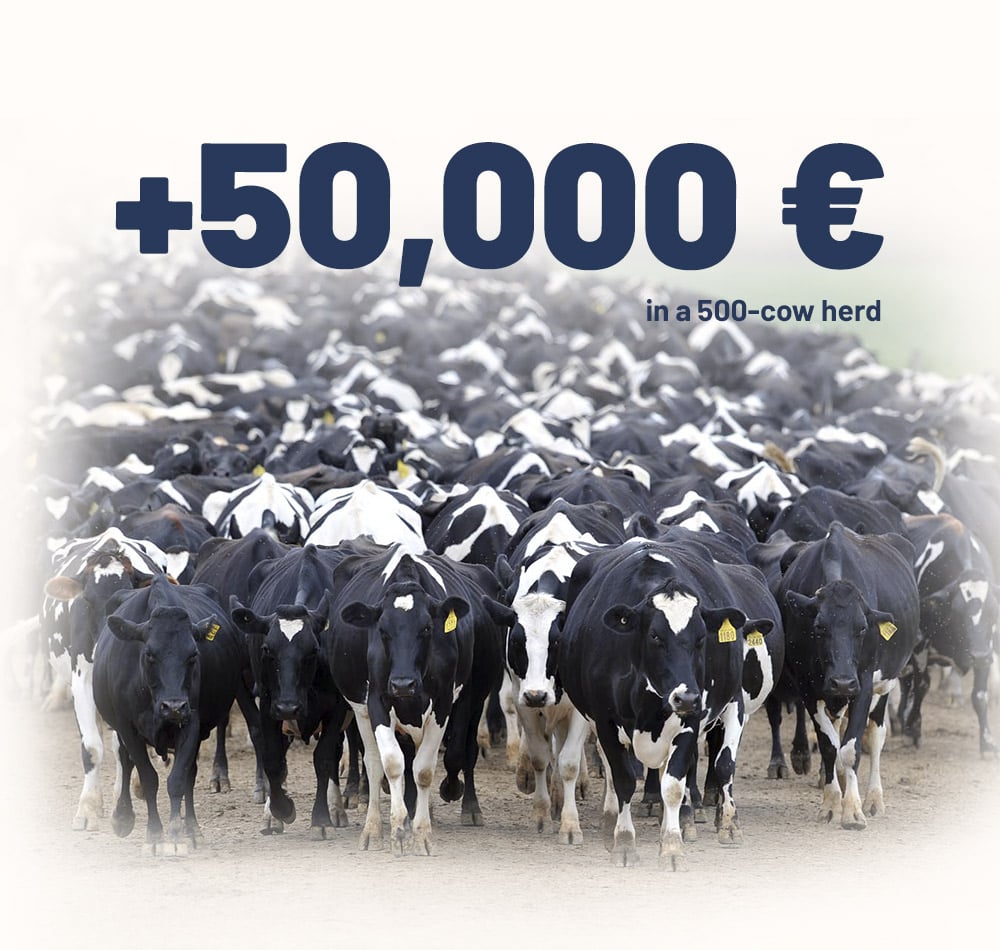
Optimizing weight management brings measurable results – delivering approximately €100 per cow per year in added value. This comes from improved fertility, healthier cows, higher milk production, and longer productive lives. The economic benefit is estimated under Nordic conditions using SimHerd, a scientifically validated simulation model that accounts for interactions between milk production, health, reproduction, and climate impact. The model simulates each cow over a 10-year period, with the analysis repeated 100 times to ensure reliable results.

CowFIT delivers approximately 50000 eur in 500 cow herd in added value.
"When inseminating my cows, I use information on when they are in positive energy balance. Even with a strong heat detection, I choose not to inseminate a cow if she is still losing weight. I have gone from 2.2 inseminations per pregnancy to 1.8 with this strategy."

Kim Jørgensen
350 VikingHolstein cows, Denmark